Saucony Guide 18 vs Saucony Guide 19
A side-by-side comparison grounded in verdicts from 3 reviewers with every source linked. We don't invent quotes; every claim below is attributed.
Specs at a glance
The consensus read
Each paragraph is a synthesis across every reviewer in our database for that shoe — what they collectively concluded after wear-testing. Not a quote. Not one person's take. The shape of the room.
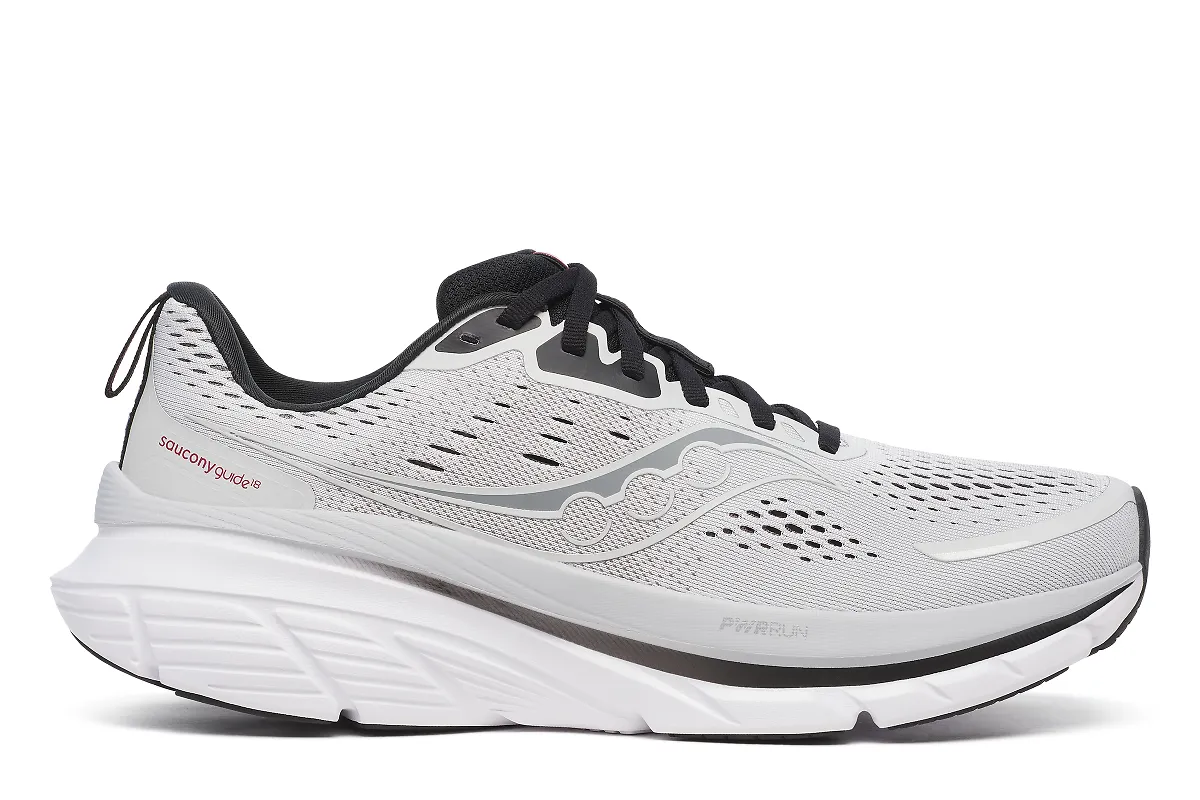
Saucony Guide 18
A mild-stability daily trainer built on a wide, smooth platform that excels for easy runs and recovery miles but lacks the energy return and outsole durability some testers seek for faster paces.
Reviewers who wore both
Direct paired observations — reviewers who actually ran in both of these and wrote the contrast. This is the strongest comparative signal on the page.
Lighter and slightly snappier, but less adaptable upper and clunkier heel transition
Heavier and softer with better outsole grip, smoother transitions, and a more adaptable upper, but less snappy
Saucony Guide 18 — what reviewers say
Ride profile: high cushion , mild_stability stability .
-
A very good mild-stability daily trainer that continues the V17 formula with small upper/comfort tweaks — solid fundamentals at a friendly price, but the PWRRUN foam leaves the ride feeling flat and Fordy still prefers the Puma ForeverRun Nitro 2's bouncier foam.
Ride:Center Path tech with raised sidewalls and wide platform provides inherent stability without posts. PWRRUN foam is good for stability but lacks pep or get-up-and-go — reviewer would prefer something with more energy return (Nitro-style).
Fit:True to size in UK 9.5. Locks down nicely with comfortable new engineered mesh upper and added foam in the heel and tongue area.
In their words: "fits true to size" · "It locks down real nice" · "It does all the basics very well"
-
A solid, comfortable cushioned stability workhorse that feels like a modern daily trainer rather than an old-school stability shoe — small updates over V17 keep it a dependable pick, though the sparse outsole rubber is a concern and the pricier Hurricane 24 still rides nicer.
Ride:Center Path tech with wide base and high sidewalls provides stability without feeling like an old-school posted stability shoe. PWRRUN midsole is firm but not clunky with a PWRRUN+ sockliner adding comfort. Smooth landing, nice rolling toe-off and consistent paces — does a light interval session OK but not made for hitting specific fast paces. Zonal outsole rubber is grippy but coverage is sparse and exposed foam worries the reviewer on wet conditions and durability.
Fit:True to size in UK 8. Roomy forefoot with slightly stretchy forgiving upper, good ankle collar padding, easy to lock down the midfoot. Also available in a wide version.
In their words: "really big wide base on it" · "doesn't really feel like a stability shoe" · "It's not a fast shoe"
-
A mild stability shoe that's fine for easy runs and walking; slightly snappier than v19 and likely the better value on sale.
In their words: "teeny bit more snappy" · "Version 18 kind of had a slight bounce" · "Version 18 was just a teeny bit stiff"
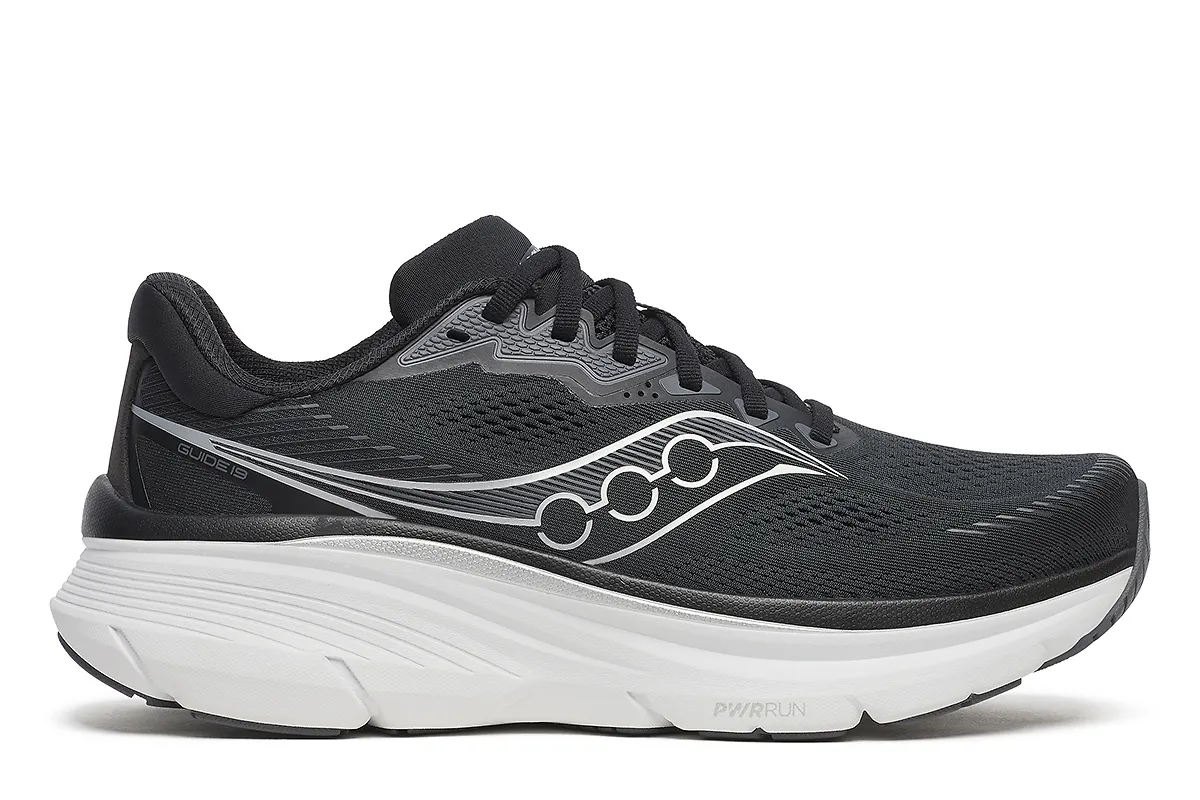
Saucony Guide 19 — what reviewers say
Ride profile: high cushion , firm_responsive feel , neutral stability .
-
A genuine breakthrough for the Guide line — the reviewers (who previously found the Guide dull) now consider it a comfortable, smooth max-cushion shoe with subtle guidance that works for mild overpronators and neutral runners alike, at a competitive £140 price.
Ride:Updated PWRRUN midsole feels softer and more energetic than prior Guides, with Center Path raised sidewalls providing subtle guidance rather than overt stability. Wide platform cradles the foot and offsets the high stack. Rolls through smoothly on easy miles, but not lively or versatile for faster paces. Thick rubber outsole gives excellent durability and grip.
Fit:Very roomy and comfortable true-to-size. High toe box with plenty of length and good forefoot width. Thin padded tongue wraps nicely without lace pinching. Heel collar padding is medium with flexible high sides that crumple to avoid Achilles pressure. Also offered in a wide version.
In their words: "very roomy fit" · "really nice max cushion shoe" · "Nails the easy mile workhorse"
-
Softer, smoother, and more durable than v18 but notably heavier and less responsive; most buyers can save money and grab v18 on sale instead.
Ride:Softer, more compliant ride with smoother heel and forefoot transitions but less responsive; heavier than v18.
Fit:Engineered mesh upper is more adaptable with slightly more volume than v18.
In their words: "a lot softer" · "smoother heel transition" · "teeny bit less stable"
-
A competent, comfortable mild-stability max-cushion daily trainer that does the basics well but lacks innovation; the reviewer would pick the Saucony Hurricane or Nike Structure Plus instead.
Ride:Smooth, comfortable ride with softer PWRRUN EVA midsole; CenterPath sidewalls seat you low for inherent stability on a wide base.
Fit:True to size with a comfortable new upper and good lockdown; gusseted tongue.
In their words: "fits bang on true to size" · "comfortable, smooth, and stable" · "run-of-the-mill daily trainer"
Who should buy which
Use cases the reviewers above actually call out — one bullet per distinct take, attributed. Where reviewers converge (e.g. "5K to half marathon" appearing across multiple takes) the agreement is a stronger buying signal than any single voice.
Consider the Saucony Guide 18 if
- Runners with mild stability needs who want a comfortable daily trainer or a kinder easy-day/recovery shoe during high-mileage marathon training. — FORDY RUNS
- Runners who want a comfortable, stable easy-day and long-run shoe for cruising miles. — The Run Testers
- Runners who want a comfortable modern stability workhorse for easy runs and consistent paced daily training — stability is there when needed but doesn't dominate the ride. — The Run Testers
- Runners who want an accessible, affordable stability shoe for easy daily miles or the end of long runs — works for neutral runners too who appreciate a cradled, rockered, consistent-pace ride. — The Run Testers
Consider the Saucony Guide 19 if
- Walkers and new/easy-pace runners who want a mild stability shoe with a high-arch feel — Doctors of Running
- Easy miles, long slow runs, walk-to-run programs and anyone wanting a comfortable max-cushion shoe with mild stability rather than heavy-handed support. — The Run Testers
- Run-of-the-mill mild stability daily training at easy paces up to half marathon distance. — FORDY RUNS
- Runners wanting a simple non-super-foam mild stability shoe and walkability. — Doctors of Running
- Mild stability in a package that isn't blocky or bulky — The Run Testers
Frequently asked questions
What's the difference between the Saucony Guide 18 and the Saucony Guide 19?
The Saucony Guide 18 is a daily trainer and the Saucony Guide 19 is a recovery / easy. By the numbers, the Saucony Guide 18 weighs 286g, has a 39mm heel stack and a 6mm drop, while the Saucony Guide 19 weighs 292g, has a 37mm heel stack and a 6mm drop. MSRP is $140 for the Saucony Guide 18 and $150 for the Saucony Guide 19.
Should I buy the Saucony Guide 18 or the Saucony Guide 19?
FORDY RUNS on the Saucony Guide 18: Runners with mild stability needs who want a comfortable daily trainer or a kinder easy-day/recovery shoe during high-mileage marathon training. Doctors of Running on the Saucony Guide 19: Walkers and new/easy-pace runners who want a mild stability shoe with a high-arch feel.
Per FORDY RUNS, Doctors of Running.
Has anyone reviewed both the Saucony Guide 18 and the Saucony Guide 19?
Yes — Doctors of Running directly compared the Saucony Guide 18 and the Saucony Guide 19 in their reviews.
Per Doctors of Running.
Which is more cushioned, the Saucony Guide 18 or the Saucony Guide 19?
Measured by stack height, the Saucony Guide 18 has more underfoot foam — 39mm at the heel versus 37mm.
Which is cheaper, the Saucony Guide 18 or the Saucony Guide 19?
The Saucony Guide 18 is cheaper at $140 versus $150 MSRP — about $10 less.